
Attic Insulation & Radiant Barrier in Tempe, AZ
Your home isn’t just hot, it’s being heated from above.
Most Arizona homes don’t have an insulation problem — they have an attic heat problem. Adding more insulation alone won’t fix it. The real solution starts with controlling where the heat comes from.

4.8 Stars · 1,000+ Google Reviews
Free Attic Assessment

BBB A+ Accredited
Attic Insulation and Radiant Barrier Across Tempe
Tempe was largely built out by the end of the 1980s, and the median home dates to 1984. That means insulation installed to older codes, decades of settling, and original ductwork in a hot attic. We have completed 1,800+ home service jobs in Tempe, and every attic job starts with a free assessment.
Delta’s Attic Performance System in Tempe brings an older attic up to Valley heat: a radiant barrier to block heat at the roof deck, a solar attic fan to exhaust superheated air, and an insulation top-off to R-30, R-38, or R-49. When old insulation is contaminated, damaged, or too compressed to perform, we remove it and sanitize the attic before installing new. You get clear options with no pressure, and financing is available.
Tempe’s housing is more mixed than most of the Valley. In the Census Bureau’s 2020–2024 American Community Survey, 41.2% of Tempe homes were built before 1980, but only 38.1% of housing units are single-family detached houses; about half are in buildings with two or more units, where the roof and attic usually belong to the building or its association. In a house, most attic work happens inside, but a solar attic fan changes the roof. If your home is listed in the Tempe Historic Property Register, the city’s Historic Preservation Office reviews exterior changes at no cost to the owner, while plans for interior work do not need its review. Tempe also notes that homeowners’ associations can enforce design standards on top of city rules, so it is worth checking both before a roof-mounted fan goes in.
Outside Tempe? See attic insulation across the Phoenix metro.
Attic insulation in nearby cities: Mesa · Scottsdale · Glendale · Chandler
More Delta services in Tempe: AC Repair · AC Maintenance · Heating
Licensed insulation contractor: Delta Air Conditioning LLC, Arizona ROC 284602 (CR-40 Insulation).
Most attics don’t have an insulation problem — they have a heat problem.
More insulation alone is like adding more buckets to a leaky roof.
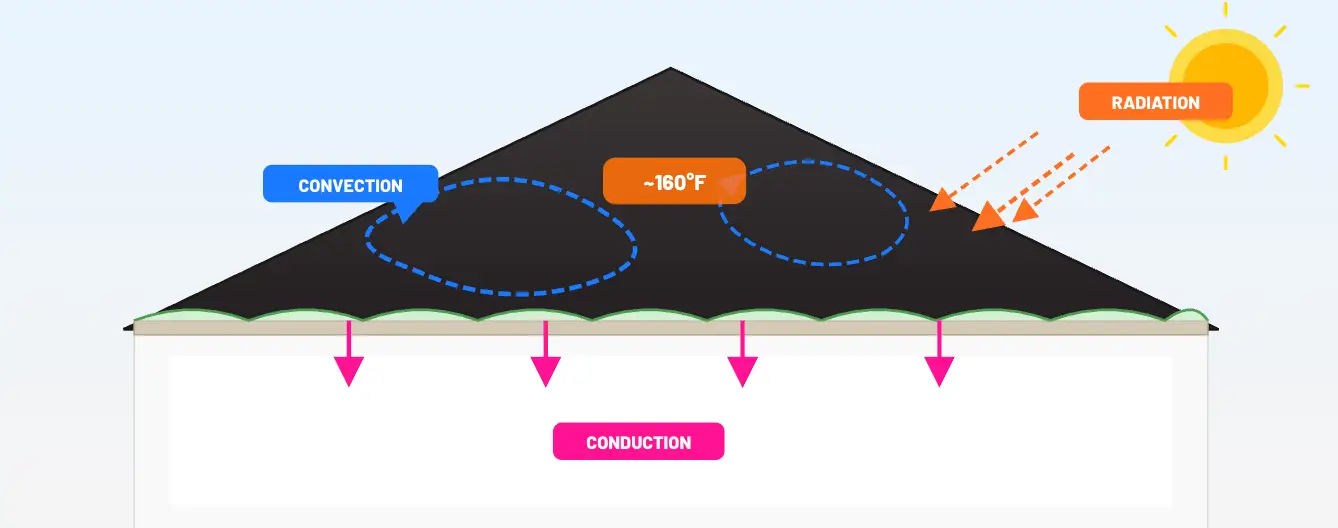
3 Ways Heat Gets Into Your Home
A real solution has to address all three — because fixing only one leaves the other two working against your comfort and your A/C.
Problem 1
Radiation
The sun hammers your roof all day. That energy radiates directly into your attic as infrared heat — super-charging the air inside and baking everything it touches
Problem 2
Convection
Once that radiant heat builds up, the air in your attic becomes a superheated oven. It circulates and rises — cooking your insulation and your ductwork from outside in.
Problem 3
Conduction
Even after the sun goes down, heat stored in attic materials slowly transfers through your ceiling — why your home still feels warm at midnight.
Our Comprehensive Solution Includes:
RADIATION BLOCKING
- Block radiant heat before it enters the attic
- Reflect up to 97% of heat away from the roofline
- Reduce the infrared heat that superheats attic air
- Help protect insulation and attic materials from extreme exposure
- Solution: Radiant Barrier
PERFORMANCE OPTIMIZATION
- Remove built-up attic heat with active ventilation
- Cycle attic air 10–12 times per hour
- Use solar-powered performance that works hardest on the hottest days
- Reduce heat buildup around ductwork and insulation
- Solution: Solar Attic Fan
EFFICIENCY IMPROVEMENTS
- Slow remaining heat transfer through the ceiling
- Improve the effectiveness of the insulation already working in the system
- Reduce the amount of stored heat entering the home after sunset
- Support more stable indoor comfort and less A/C strain
- Solution: Upgraded Insulation
We Don’t Just Add Insulation.
We Control the Heat.
Block It
Stop Radiation First
A radiant barrier reflects up to 97% of radiant heat before it ever enters your attic — originally developed by NASA for the extreme demands of space.
Product: Radiant Barrier
Remove It
Actively Exhaust Heat
A solar attic fan cycles your attic air 10–12 times per hour — free solar energy, working hardest on the hottest days, exactly when you need relief most.
Product: Solar Attic Fan
Slow It
Resist What Remains
With radiant heat blocked and convective heat flushed out, your insulation only has to resist a fraction of its original load — making it dramatically more effective.
Product: Upgraded Insulation
Your Home Is Unique.
So Is Our Recommendation.
Every attic is different. The right insulation level for your home depends on what’s already there, how your attic is ventilated, and the specific heat load your home carries.
We don’t sell a one-size-fits-all package. We assess your attic, look at existing conditions, and recommend the R-value that makes the most sense for your specific home — then show you the full range of options clearly.
1
Free Attic Assessment
- Inspect current insulation levels and overall attic condition
- Evaluate attic ventilation and heat buildup patterns
- Identify problem areas affecting comfort and A/C performance
- Measure the attic’s current heat load and system demands
- Note any damage, contamination, or removal needs
2
Honest Recommendation
- Recommend the right R-value based on your home’s conditions
- Explain whether R-30, R-38, or R-49 makes the most sense
- Show clear package options with no pressure
- Walk you through the full system and what’s included
- Let you choose the solution that fits your priorities and budget
3
You Choose
We present all options and let you decide what fits your priorities and budget.
- R-30 (Good): Starter level for under-insulated homes
- R-38 (Better): recommended when adding to existing insulation
- R-49 (Best): recommended for an uninsulated attic
All packages include the full system. Only the R-value changes.
Three Clear Options
Every package includes the same complete system
The only difference is the R-value we add.
Included in Every Package:
- Radiant Barrier Installation
- Solar Attic Fan Installation
- Insulation Top-Off (varies)

GOOD – R-30
Attic Heat Reduction Package
A strong foundation. Addresses all 3 heat problems for under-insulated homes.
- Radiant Barrier: Blocks up to 97% of radiant heat
- Solar Attic Fan: Flushes trapped heat
- R-30 insulation top-off

BETTER – R-38
Attic Performance Package
A balanced upgrade. ENERGY STAR’s recommended level when adding to existing attic insulation in Phoenix’s climate.
- Radiant Barrier: Blocks up to 97% of radiant heat
- Solar Attic Fan: Flushes trapped heat
- R-38 insulation top-off

BEST – R-49
Complete Attic Optimization System
Maximum performance. Built for the highest level of thermal protection.
- Radiant Barrier: Blocks up to 97% of radiant heat
- Solar Attic Fan: Flushes trapped heat
- R-49 insulation top-off
Need a Full Attic Restoration?
Insulation Removal & Sanitization
Old insulation must be safely removed and the attic disinfected before installing a new system.
Includes:
- Full insulation removal
- Attic sanitization
- Clean-start installation
What Homeowners Notice
- More Even Temperatures: Rooms feel consistent across the home
- Improved Comfort: A/C runs more normally
- Reduced Attic Heat: Cooler attic and ductwork
- Less A/C Strain: Longer system lifespan
- Potential Energy Savings: Lower monthly bills
- Cooler Nights: Less stored heat radiating after sunset

You Deserve a Guide, Not a Sales Pitch
The repairs you need. The confidence you deserve.
Why Choose Delta?
- Clear Options, No Pressure: We present what we found and what we recommend. You decide. No high-pressure tactics — ever.
- Serving Arizona Homeowners Since 2003: We work specifically in Phoenix and the valley. We know what homes here face — and how to solve it properly for our climate.
- Whole-System Thinking: We treat your attic as an ecosystem. Every component is sized and installed to work together as a complete solution.
- Honest Assessments & Upfront Pricing: We tell you what we found, explain options in plain English, and give you complete pricing before any work begins.
Our Promise To You
- Free attic assessment — no obligation
- All 3 forms of heat gain addressed
- R-value recommendation based on your home
- Honest pricing — no hidden fees
- Arizona-based and family-owned, serving Phoenix since 2003

Ready to Fix the Problem, Not Just Cover It Up?
Schedule your free attic assessment. We’ll tell you exactly what your home needs — no pressure, no guesswork.
Call (623) 240-9892 for:
- Free Attic Assessment
- Free Estimates on New Installations
- Honest Advice on Repairs vs. Replacement
Attic and Insulation Questions from Tempe Homeowners
What does a 40-year-old Tempe attic usually need?
Most Tempe homes were insulated to the codes of the 1960s through the 1980s, and loose-fill insulation settles over time, so the first finding is usually low insulation depth. We look at your attic and explain your options. The assessment covers all of it, and the recommendation starts with what will make the biggest difference.
Can you add insulation to a Tempe home with a low-slope roof?
Usually, yes. Low-slope roofs leave a shallow attic, which limits how much can be added and how easily a technician can reach the edges. Blown-in insulation works well in these spaces because it can be placed evenly from the center of the attic. If the cavity is too shallow for a meaningful top-off, we will say so during the assessment.
Does a solar attic fan need to be wired into my Tempe home’s electrical panel?
No. A solar attic fan is powered by its own small solar panel, so it does not draw from your electrical service or need a new circuit. That matters in older Tempe homes where the panel has little spare capacity. It does need enough intake venting to work properly. We look at your attic and explain your options.
What does the free attic assessment in Tempe include?
We inspect the insulation level and the attic’s overall condition, evaluate ventilation and heat buildup, identify problem areas affecting comfort and AC performance, and note any damage, contamination, or removal needs. You then get a recommendation for R-30, R-38, or R-49 with clear package options, and you decide with no pressure.